 March-April 1999
March-April 1999


Edited by Scott Daniels
In a few months, the Boy Scouts of America will kick off its first-ever nationally coordinated Cub Scout round-up. The rumors are true: Garfield is joining the Cub Scouts!
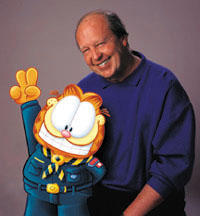 Jim Davis and our Spokescat Photo-Illustration courtesy of Paws Inc. |
Jim Davis, creator of the popular cartoon feline Garfield, through his company Paws, Inc., has gifted to the National Council, Boy Scouts of America, a license to utilize the Garfield characters in conjunction with the national round-up.
This unique campaign - which will have the lovable, wisecracking cartoon character Garfield as its SPOKESCAT - is designed to use Garfield's image to maximize the recruitment of new members and create interest and generate enthusiasm in its participants.
Highlights of the Garfield Round-Up include
In a news release, Jim Davis said: "Scouts are as American as lasagna. Garfield and Scouting make a purrfect team."
Garfield as round-up SPOKESCAT was test-marketed for two years in the Crossroads of America Council, Indianapolis, Ind.
- Kathy Vilim DaGroomes
(Editor's note: Look for the September 1999 issue of Scouting magazine for more information on the Garfield Round-Up's development and implementation.)
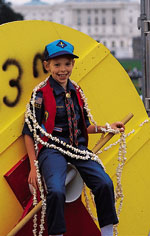 Scouting units nationwide helped put together this 16-mile-long popcorn string. Photograph courtesy of Trail's End Popcorn Co. |
How many kernels does it take to make a popcorn string 16 miles long? According to Trail's End Popcorn Co., Scouts used more than two million popped kernels to make a string that was displayed last October in front of the U.S. Capitol building.
More than 25,000 Cub Scouts, Boy Scouts, and Venturers (and 5,000 adult helpers) from 86 cities in the United States and Canada helped put the big string together. Trail's End, which supplies popcorn products to units to sell as a money-earning project, brought the string to Washington, D.C., rolled up on three huge spools.
The idea to make a giant popcorn string started with Scouts from the Three Fires Council in St. Charles, Ill. Trail's End then adopted it as a way to publicize Scout popcorn sales while bringing attention to Scouting activities and attracting more youth members.
Local publicity events were held at many stops during the tour. For example, in Twin Falls, Idaho, Cub Scouts and Boy Scouts from the Snake River Council extended a popcorn string across the 1,500-foot Perrine Bridge. Area media reporters turned out to record the Scouts' rim-to-rim "crossing" of the Snake River Canyon, a span once made famous by daredevil Evel Knievel's failure to jump across via motorcycle.
Study says top students cheat
At the same time a new BSA study shows how Scouting's programs help to instill strong personal values and character in youth, another national study offers evidence of why American youth desperately need such programs.
The BSA study, A Year in the Life of a Cub Scout ... Boy Scout ... Venturer: Strengthening Youth, Families, and Neighborhoods, shows, for example, that Cub Scouting meets or exceeds the expectations of parents on teaching ethical and moral values. (A 14-page pamphlet summary, No. 02-303, is available at council service centers.)
At the same time, the 29th Annual Survey of High Achievers, conducted by Who's Who Among American High School Students, reveals that 80 percent of the high school students honored by the Who's Who publication admit to having cheated during their academic careers - the highest percentage in the 29-year history of the survey.
Nearly all (95 percent) of those who admitted cheating avoided getting caught, which could explain why more than half (53 percent) believe their own ethical slips were "no big deal."
At the same time, however, nearly twice as many students in 1998 versus 1997 point to "declining social and moral values" as the biggest problem facing their generation. (Crime and violence, cited by 15 percent, came in a distant second.)
Other results include large leaps in levels of prejudice against homosexuals (up 19 percent from 1997) and against African-Americans and Hispanics (15 percent versus only 7 percent in 1997).
The survey's positive results included a sharp drop in those who mix driving and drinking (from 10 down to 4 percent) and those who have ridden with a driver who had been drinking - from 24 down to 9 percent.
The Who's Who annual survey was conducted among 3,123 high-achieving 16- to 18-year-old students, all of whom have an A or B average, and 97 percent of whom plan to attend college after high school graduation.
Americans value volunteering
The rate of Americans volunteering to help their communities is increasing. A recent survey on volunteerism conducted by Yankelovich Partners for the Lutheran Brotherhood shows that Americans also appreciate the importance of giving their time to help others.
The survey found that
The following newly published materials are available for Webelos Scouts and Venturing leaders. They will be available at council service centers, Scout shops and distributors, or by mail from the BSA National Distribution Center, P.O. Box 65989, Charlotte, NC 28265-0989. [For information or to place a credit card order, call (800) 323-0732.]
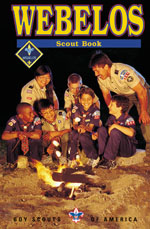
New material includes information about the Cub Scout Sports and Academics programs, and a Webelos advancement tracking chart. The book costs $5.50.
Scouts from troops within the Scoutreach program in four councils attended the 12th Nippon Jamboree in Japan last August as part of the Boy Scouts of Nippon and Boy Scouts of America Friendship Program.
 Scouts from four BSA councils visited the 12th Nippon Jamboree last summer in a friendship program between U.S. and Japanese Scouts. Photograph courtesy of BSA Scoutreach Division |
The 32 Scouts and four adult leaders also took an educational tour, lived for three days with individual Japanese families, and participated in an international youth forum and cultural exchange program.
"I learned a great deal about what exists past the boundaries of the United States and how different we all are," said Eagle Scout Robert Dawson of the Atlanta Area Council. "I experienced Scouting at its simplest ideal - world brotherhood."
"The Japanese people are very polite and love to give gifts," said Scout Lionel Pringle of the South Florida Council. "Customs are a key part of their culture, and they helped me to realize their rich importance."
"The home stays allowed us to experience Japanese culture with a Japanese family," reported Scout David Hwang of the Orange County Council. "The visits also helped to bring our group of Scouts together, as each boy had his own personal experience and wanted to share it with the others."
The five-year Boy Scouts of Nippon and Boy Scouts of America Friendship Program is designed to further international understanding and is based on the April 1996 message of Japanese Prime Minister Ryutaro Hashimoto and U.S. President Bill Clinton.
The 1998 index for Scouting magazine is available, as well as indexes for each year back to 1970.
For each index, send a self-addressed, stamped, business-letter envelope; for more than three, send a larger envelope with one first-class stamp for each index requested. Order the indexes from Scouting Magazine Index, S204, P.O. Box 152079, Irving, TX 75015-2079.
Scouting magazine indexes for recent years are also available on the Scouting Magazine site.
Arbor Day: a time for trees
The last Friday in April is traditionally National Arbor Day, a historical event celebrating trees and wise environmental stewardship. (Many states, however, designate different days, or even weeks, for the occasion.)
The National Arbor Day Foundation provides materials and information on conservation, planting and caring for trees, and teaching youth about trees. These include a free packet, "Celebrate Arbor Day!" (item no. 1190), on planning an Arbor Day celebration or event. To order the packet or get information about other materials, contact The National Arbor Day Foundation, 100 Arbor Ave., Nebraska City, NE 68410, http://www.arborday.org.
Youth target smoking in April
Thousands of young people are launching plans for the fourth annual Kick Butts Day, April 14. Aimed at curbing tobacco use among kids and exposing harmful youth-targeted marketing tactics, Kick Butts Day mobilizes America's kids as leaders and advocates. This year's activities will include
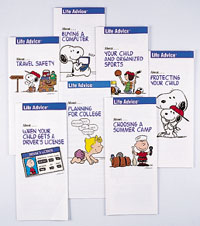
Buying a computer? Planning for college? Choosing a pet?
Help is available from the MetLife Consumer Education Center in a series of more than 80 free brochures.
Created in conjunction with nationally recognized authorities, the "Life Advice" series of brochures discusses such issues as life transitions; finances; health; major purchases; family, business and legal issues; retirement; making a will; and buying or selling your home. Each brochure also includes a list of additional resources and reference materials.
To request a brochure, call (800) 638-5433. The information in many "Life Advice" brochures may also be accessed on the Internet at http://www.lifeadvice.com.
The F.B.I. estimates that more than 500,000 bicycles, with an average value of $286 each, were stolen in 1995. To protect your bicycle from theft, consider the following:
To help Scout groups who use the land and property of others for hiking, camping, and other activities, the BSA Council Services Division provides these guidelines:
| The Boy Scouts of America |  |
http://www.scouting.org |