 January-February 1999
January-February 1999


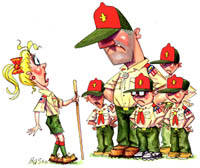
Scouting is full of "good old boys" who feel that since Boy Scouting is for boys, only men should work in the program. I have found that the only way to oppose them is to doggedly do my job well, while looking like a woman, until they notice.
It may take years for them to acknowledge M.B. It took a lifetime for such men to learn the male chauvinist way, and it takes longer to change behavior than the mind.
The boys and young adult leaders will accept M.B. long before the good old boys do, so she should not be discouraged.
Scoutmaster C.H.
Helper, Utah
Inappropriate behaviors should not be tolerated, especially from someone with the important position and influence of Scoutmaster.
The answer may be simply to make him aware of your concerns by addressing the problem at the next troop committee meeting. If the problem continues, the committee may have to consider replacing him.
Assistant Scoutmaster M.A.
Sunrise, Fla.
Unless the Scoutmaster is engaging in behavior that is overtly sexist, which has no place in Scouting, M.B. and other women who support the troop will probably be best served by continuing to be good examples. Attempting to confront or resocialize the Scoutmaster would be difficult and would be potentially fatal for the troop.
I have seen more than one leader overcome his bias simply through persistent contact with competent people who are different in some way from him.
Former Scoutmaster J.E.
Baltimore, Md.
I am fortunate being in a troop with a Scoutmaster who believes it is important for boys to recognize women's contributions to society both as nurturers and leaders.
If I were M.B., here are things I would do:
B.K.
Villa Grove, Ill.
I had the same problem, except that the sexist was not the Scoutmaster. As a single parent, I was determined to be involved in the troop (there are too many single-mother families today to exclude women from leadership). Here is my advice to M.B.:
Assistant Scoutmaster J.M.H.
Springfield, Ore.
As a Scouter in my son's troop, I was lucky to work with a Scoutmaster who encouraged women to participate.
Over the years more and more women have become involved in Boy Scouting. The Scoutmastership Fundamentals course emphasizes adult associations, not just male associations, as explained in the pamphlet "The Aims and Methods of Boy Scouting" (BSA Bin No. 18-917).
If M.B.'s Scoutmaster has been in Scouting more than 10 years, the troop committee should suggest that he attend the next Scoutmastership Fundamentals course to update him on current Scouting procedures. The unit commissioner or district commissioner might also discuss it with him.
If the Scoutmaster refuses to attend the training session, or if he does but his attitude is not changed, M.B. should ask whether this is a role model she wants for her son. If not, she might begin looking for another troop.
District Scoutmastership Fundamentals Course Director J.B.
Fort Collins, Colo.
As a pack committee chair, I can testify to the value of committed adults - both men and women - in a Scouting program. The best examples of what we want our young men to become are the adult leaders who set the right example.
M.B. should talk to her troop committee chair or bring the issue to the committee as a whole.
Pack Committee Chair D.S.S.
Tigard, Ore.
Activities for Cubs Scouts with DisabilitiesSeveral boys in our pack have disabilities. Some face mobility challenges, others have learning disabilities. What are some specific ways leaders can modify Cub Scout activities and advancement so that all these boys can participate in a meaningful Cub Scouting program? Albany, Ga. Send your answers to Front Line Stuff, Scouting magazine, 1325 W. Walnut Hill Ln., P.O. Box 152079, Irving, TX 75015-2079. Responses will appear in Scouting's May-June issue. We also solicit new questions of a provocative nature and pay $50 for each one used in this column. |
| The Boy Scouts of America |  |
http://www.scouting.org |